Sunday, August 29, 2010

Selling Your Intent


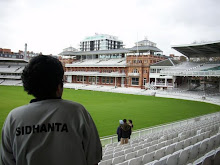
Representing one’s country is something everyone dreams of but a very few go on to achieve and that is why those who attain it are seen as special. They not only carry the pride of the nation on their sleeves but also act as an inspiration to their generation and propel youngsters to strive towards bigger goals. Especially in the Asian subcontinent where the sociological conditions are not always great and every day is a challenge in its own way these stars are hailed and revered as their escapades are an avenue to detach oneself from the grinds of the daily mundane life and that is one of the primary reason for cricket’s meteoric rise in Pakistan and India. The personal milestones of players are considered to be achievements of the citizens who could not break their shackles and it offers content for casual conversations in public joints and dinner tables across the geographical stretch. It is not a secret why Asian cricketers are the fulcrum to any ICC competition’s market profitability.

The players thrive on their popularity and the stardom status as they are aware of the roots, having travelled the same lanes and gone through the identical routine for years before wearing the country cap. While in their moulding stage many sleepless nights are spent dreaming and visualising the role of being a match winner in a world cup final or having the name enrolled on the honours board at the home of cricket. They rehearsal the victory laps, the celebratory antics and the stares at the opponent in front of their mirror at the expense of their social life and promise to themselves of remaining firmly intact with their background when the reality takes centre stage.

The selector’s phone call opens the door to international prominence and with it comes the biggest challenge of protecting one’s sanity of living up to the promises made in front of the mirror. The past has witnessed an enriching number of excellent craftsmen coming through the pipeline but the ‘legends’ differentiated themselves from the rest through their moral values and simplistic lifestyle which earned them respect in every country they played in whereas the stars have always been susceptible to the clutches of glamour that looks for opportunities to strengthen its claws on these ‘innocent’ minds. The same continues to be the scenario today as the lure of commercial riches have raised key questions on the mental toughness yet again and has resulted in the nation’s pride being tainted.

It is easy to point fingers at the parent body but no coaching and no education can teach a person the virtues of having the right intent and strong character. Citizens of a geographical zone where instability is the order of the day have every right to be disappointed but what about the individual’s promise much before he earned his cap. Did all those promises made in front of the mirror not haunt him before he overstepped the line or did he succumb to an uncontrollable environment which was set up by his fellow team mates? Can the youngster’s parents who were proudly boasting of their son’s heroic in a separate continent now visit their nearest grocery shop or resume their daily chores after this lustful act of their son. Did it all mean nothing when he used his bargaining power to tilt the equation in balance of ‘acts of shame’.

The beauty of sports lies in its ability to bring the best out of the performers without an assurance on the result in a fiercely competitive atmosphere but the noise in the media suggest that the line is slowly disappearing and if the allegations are true then sport might just have lost its unique advantage.


Sidhanta Patnaik

29th August 2010

18.38

Sheffield


(This piece was written after the completion of 4th test between England and Pakistan at Lord’s played from 26th – 29th August where Mohammed Asif and Mohammed Amir were alleged to have bowled no-balls which were pre planned for an exchanged amount of £150,000)

Friday, August 6, 2010

Indian Football - Just Do It

The mention of Indian football raises eyebrows because of its inability to produce an internationally successful team. Since yesterday (5th August 2010) was my first live experience of watching an Indian football team play in an international competition, I do not qualify to point out the system’s loopholes and moreover I have never made an earnest attempt to understand the dynamics of Indian football set up. However after witnessing Shillong Lajong Football Club represent India at Manchester United Premier Cup 2010 (MUPC) , I had enough reasons to be convinced that though India may not qualify for 2014 FIFA world cup yet there lies hope for the future.

MUPC has been a regular fixture in the international football calendar since 1993 with able support from Nike and is held at Manchester United’s practice grounds in Carrington. This year the under 15 teams of various clubs in 43 nations competed in their respective country and the winners qualified for the zonal finals. The top 20 club teams booked their flight to Manchester to compete in the finals (The Indian winners have got direct entry into the finals since 2 years). India’s Shillong Lajong Football Club was slotted in group A and lost all the four group matches without scoring a single goal and conceded 15 goals. It will play its table positioning match today afternoon and will attempt to avoid the wooden spoon. Had results and statistics been the only measure for judging a team’s performance and in the process a country’s progress in a particular sport then this drubbing experience counts for little but the journey begins where the score line halts.

For long, Indian football was majorly restricted to Goa, Kerala and West Bengal and there were only a handful of clubs that were recognised nationally. Matters were in a state of shamble because no corporate was interested to engage itself in a relationship with the All India Football Federation (AIFF) because the bureaucratic system had made the parent body directionless. There has not been a major transitional change in the ground realities however Nike, india has taken the first giant step in building a process that could help the game penetrate into the grassroots among the wider segment of the society and in the process give the due recognition to this wonderful sport in the second most populous country in the years to come. By engaging more that 70 clubs across the country at the pre qualifying stage and 32 clubs in the finals of the MUPC country qualifying round, Nike India has sparked a football movement among the youngsters of the country who a few years back irrespective of their possessed talent were clueless about how the game would benefit them. Last year Salgaocar Sports Club represented India in the finals and this year the city of Shillong gained prominence in the world football map. This is a clear sign of how right intent and dedicated effort can create a platform for anyone in any corner of the world to gain global reputation in this boundary less environment.

Today after the match when I looked into the eyes of these young footballers, they were beaming with confidence and the grin on their face was that of happiness and satisfaction of having done something under the country’s banner at such a young age. At the age of 15 or less these players are highly spirited and too young to be saddened by the defeats. For them what matters is a chance to play the game that they love the most in an environment that their seniors would not have dreamt of in the past. Shillong Lajong FC may end up as the 20th ranked team of the tournament but the opportunity to have played a few matches in Europe and the exposure gained will remain with these skilled players for their entire life and if the administrators understand the significance of this movement that Nike, India has initiated then these moments of truths can be leveraged to take the campaign to an entirely new level. If there has to be a fairytale plot then in this decade, a few Indian names might figure in the starting line up of the premier European football clubs.

On 8th August, Shillong Lajong FC players will land in Mumbai followed by a 36 hours train journey to Guwahati and then another three hours on road in three Tata Sumos* to reach their home town. The tiredness of the journey will disappear in no time as the city will be waiting to ceremonially welcome its boys who have made the country proud and will remain as the only Indian football team to have played in an international tournament in the European continent in the year 2010.

This is the beginning.

*Tata Sumo – It is an Indian four wheeler with a seating capacity of 12.

Sidhanta Patnaik
Sheffield
2.16am
6th August 2010

On 13th March 2010, NDTV had done a special 20 minutes programme on Shillong Lajong FC (http://www.ndtv.com/news/videos/video_player.php?id=1208811)

(Special thanks to Siddhant Narayan from Nike, India for having invited me to watch Shillong Lajong FC play in MUPC 2010)

English league cricket – Window of opportunity for Orissa cricketers

The old adage of ‘practice makes a man perfect’ fits well for the game of cricket in India where the demands and expectations have changed in the last decade. With the evolution of Twenty 20 cricket, hike in the pay structure of domestic cricketers and boost in the volume of matches played in various competitions, the requirement for quality players has increased enormously and every single performance makes an impact unlike the case in the past. Therefore for a professional who plays the game for a living, the pressure is twofold to convert every single opportunity into an outstanding performance in order to secure his financial position and aspire to go on to achieve bigger things.

Board of Control for Cricket in India’s (BCCI) scheduling allows a cricketer to play matches in a series of tournaments and leagues from November when the Ranji Trophy season starts till May when the Indian Premier League (IPL) ends. However for a player, one level below international cricket, the calendar offers not much encouragement during the offseason between May and October due to weather constraints. In Orissa, apart from the Kalahandi cup there is not much to look forward to during this phase. Without match practice, it becomes really challenging for a player to remain in his prime touch and with the calendar getting crowded every season, the onus lies on the individual to prepare himself during the offseason in the best possible manner in order to hold a chance to get spotted by a talent seeker.

This is where the role of league cricket becomes so important. The massive league structure of The United Kingdom (UK)* offers the best solution with cricket being played in the European continent only between April and August. The window of opportunity opens up for every cricketer across the globe who is focussed on making the best usage of the offseason and Orissa cricketers have taken to it like duck to water. It is a culture that started developing in the state during early 2000s and gained significant prominence and as a phenomenon is slowly seeping into the roots of Orissa cricket which will reap benefits for the state in the years to come. The success of many state cricketers can be credited to their proactive step of continuously playing in English league, prominent among them are SS Das, Pravanjan Mullick, Rashmi Ranjan Parida, Deepak Mangaraj, Niranjan Behera amongst others. They also need to be recognised for the efforts taken in building a pipeline through which they have over the period introduced many young talented players from Orissa to clubs in various leagues in UK.

Though many view it is an off season bonanza to earn some extra penny in a circuit where the levels are a tinge below first class level yet the importance of league cricket goes beyond the runs scored and wickets taken and plays a significant role in shaping up a youngster’s career. Make no mistake, it is no paid holiday. Performance is the only true friend for the professionals who join these clubs and the moment the graph takes a dip southward, the work ethic and level of commitment comes under scrutiny because for these clubs, the professional is a product they have invested in with an aim to derive the maximum economic value out of him before the season expires.

Apart from acclimatising to new conditions, working on weaknesses and putting in the hard steps away from the constant media glare, this stint offers lessons beyond the cricket field and prepares a cricketer for the bigger challenges that lay ahead. A stint here offers the right experience and exposes the players to turf wickets at quite an early age which is a rarity in Orissa cricket (Though of late, OCA has taken initiatives to encourage clubs to come up with their own turf wickets). Beyond the on field performances, the players get a picture of the global cricketing world which enhances their spectrum and gives them an opportunity to communicate with foreign cricketers and learn their style of game and add new skills to the repertoire. The season also gives them the chance to be involved with the game at an altogether different level by engaging themselves in cricket development projects around the club which might include coaching the kids or preparing a turf wicket or maintaining the ground. All this puts the player in the process that not only enhances his level of confidence and leadership skills but also shapes up his off field mannerism and character. This eventually reflects on their scorecard which can only benefit the teams that they go on to represent in the future.

There have been constant criticism in the cricketing circle of Orissa about the disadvantages of playing league cricket as a youngster and the opinions may be credible however during the offseason it is much better an option to enhance ones credibility and peep into an alternative future rather than wildering in the darkness and whiling away time in public joints doing things that one is not always proud of.

With the past generation of Orissa cricketers having led the path now it is up to the present young generation to take decisions and enrol with clubs in UK in order to prudently shape their careers as league cricket is a way to ensure that opportunity meets luck at the right time at the right place. After all today cricket is a mainstream profession that offers an opportunity to make a living.

* United Kingdom constitutes of England, Scotland and Ireland

Sidhanta Patnaik
Sheffield

(This piece was produced at 1.53am on 31st July 2010 and was published in www.orisports.com on 2nd August 2010)

http://orisports.com/NewsDetails.aspx?nId=MjUxMg%3D%3D

Sunday, July 25, 2010

Ranji Trophy Scheduling - Did Orissa Cricket Association miss the plot?

The responsibility of ensuring that the game of cricket remains to be the number one sport in the country lies with everyone involved with the game at any level. It is one huge family with over a billion members that can only get stronger in the future. Today cricket is at an advantage but with the generation cycle changing, the youth starting to find interest in other avenues and with the disposable income of families being targeted by various other modes of entertainment and sports solution providers, it is the prerogative of the representative of state cricket associations to market and package the game in a way that could engage more people than ever before and would keep the interest alive and competition away.

First class cricket matches in tier 2 and tier 3 cities are festive occasions that create a sense of community feeling, bring the city together and trigger a reason for happiness. For the sake of cricket lovers state cricket authorities should ride on this euphoric phenomenon and take the game much deeper into the roots and ensure that it spreads across a wider spectrum of the society. For fans to continue talking about upcoming players like Sumitosh Praharaj or Dhiraj Singh like the way they discussed about Sanjay Satapathy or Ajay Barik a decade back it is important for the controllers of the game to understand that the kid studying in Deepika English Medium School, Rourkela needs his dose of stars and live competitive cricket to remain motivated and continue dreaming of making a career in this beautiful game either as a player or as someone who could go on to facilitate the execution of the game in the years to come.

The moments generated out of watching a live cricket match involving stars goes a long way in inspiring the youngsters to love and live the game. While watching Rahul Dravid is only confined to bigger cities due to lack of international level infrastructure elsewhere, witnessing some classy performances by first class stars in any city and on any ground can be made possible by the state cricket associations if proper intent and interest is shown.

Karnataka State Cricket Association (KSCA) needs to be applauded for having taken proactive steps in this direction by first conceptualising Karnataka Premier League (KPL) in 2009 and then awarding hosting rights for the second season to smaller cities such as Hubli, Manipal and Mysore. The 2009 Ranji Trophy finals in Mysore attracted 5000 people to the Gangothri Glades Cricket Ground, it is a point showcasing the clear gap between excessive demand and shortage of supply for live competitive cricket in tier 2 and tier 3 cities. It is time for Orissa Cricket Association (OCA) to sense the opportunity, understand the dynamics of the Indian domestic cricket market and act prudently before it is too late.

OCA may justify its decision of hosting all the three home Ranji Trophy matches of 2010 season in Cuttack and the explanation handed out may be rational and apt but in the bargain the game continues to lose a large percentage of growth rate. The argument may cite Cuttack offering the required home advantage but the undercurrent that flows beneath the decision is an open secret.

Baroda’s Irfan Pathan may or may not play for the country anymore but for a cricket fanatic in Sambalpur, Puri or Balasore, he still is a big name and clicking a photograph with him or taking his autograph still holds good to be a prized memorabilia material in the living room. It is the responsibility of the authorities of the game within the state to channelize the funding of BCCI and develop the grassroots in earmarked locations apart from Cuttack and Bhubaneswar to ensure that live competitive cricket is a regular occurrence in the calendar rather than once in a while occasion.

On a concluding note, in the the 1997-1998 season, prior to the internet explosion when Orissa played Karnataka in a Ranji Trophy match in Rourkela involving a few international stars, it was a massive hit among the local community. Now with cricket websites having created statistical stars out of first class cricketers, it is quite tempting to visualise the potential that remains to be explored.

Sidhanta Patnaik
This piece was produced at 9.55pm on 21st July 2010 while on the way from London to Sheffield and was published in www.orisports.com on 24th July 2010

For the 2010-2011 Ranji Trophy season, Orissa is in the elite group B and the schedule is as follows:

November 1 to 4: Vs Baroda at Cuttack.
November 10 to 13: Vs Uttar Pradesh at Kanpur.
November 24 to 27: Vs Karnataka at Bangalore.
December 1 to 4: Vs Punjab at Cuttack.
December 8 to 11: Vs Himachal Pradesh at Cuttack.
December 15 to 18: Vs Haryana in Haryana.

Probables for 2010-2011 season: Shiv Sundar Das, Bikash Swarup Pati, Paresh Patel, Natraj Behera, Niranjan Behera, Rakesh Mohanty, Subit Biswal, Rashmi Ranjan Das, Biplab Samantaray, Gobind Podder, Partha Sarathi Patnaik, Sandeep Mulia, Haladhar Das, Subhrajit Sahu, Anshuman Gope, Debasis Mohanty, Basant Mohanty, Alok Sahoo, Santosh Jena, Deepak Behera, Preetamjeet Das, Alok Mangaraj, Dhiraj Singh, Manas Muduli, Lagnajit Samal, Bibhudutta Panda.

Thursday, July 22, 2010

Watching Mark Ramprakash Bat

Mark Ramprakash was always a batsman I wanted to see play. It is not for nothing that he has been playing first class cricket before I went to kindergarten. For his sheer longevity he to me epitomises as one of those cricketer who connects the traditionalists of the game with the modern commercial environment. At times when the debate of whether the longer version of the game will survive or not comes up, it is a player like him who lends credibility and face to the authenticity of the format.

Watching an institution of runs like him continue his never ending journey of grinding runs day after day, session by session, hour after hour in the English county circuit is a free access to lessons on patience, perseverance, intensity and determination. For anyone who knows the deeper meaning of the game much beyond the wickets and runs on display, watching him bat is a top priority over other not so important commitments as it takes the follower back to those days when the plain simple sound of the ball hitting the bat meant the world rather than discussions revolving around which format of the game would survive and which would not.

The beauty of watching him is that he makes his job look classy which actually is not. The sense of responsibility he brings on with him, the value he attaches to his wicket and the willingness to take those blows one after one without bowing down is what makes him what he is. Playing those focussed dodgy innings and being prepared to look ugly in order to be able to get the team’s job done is what creates an aura around him and associates a sense of romance to his name. For anyone who follows the game at a level below international cricket, Mark Ramprakash is a legend, a name that means bricks of runs without any holes.

Since childhood, I have followed his scores on internet and more than the runs scored, I have been interested in the number of balls constituting that particular innings because to me that speaks about the man’s character. Watching him play live for the first time, I have absorbed with key interest, every ball he left and every defensive stroke he played in the 106 balls he had faced up till this point for his 50. Those moments make me curious to know what goes on between his ears that motivates him and inspires him to play the way he plays. The best I could do was pose with him for a photograph quite aptly with The Brit Oval as the backdrop, the ground which hosted the first test match in the northern hemisphere way back in 1880.

By witnessing his 1000th run of the 2010 county championship season, I have become a small part of his ageless journey. I can only wish him luck and hope that somewhere somehow another chance will be created for me to witness yet another innings of his before he finally decides to explore greener pastures.

He is one of those rare servants of the game who has created an international impact at the domestic level. As a batsman, Mark Ramprakash holds certain traits and possesses a rare art. Only time will be able to answer whether this rare form will continue to exist and excite in the future or not.

On a concluding note, the way he tackled the bouncer at 2.35pm and then followed up with a spectacular square cut for four runs at 2.36pm makes him a monumental figure and keeps me interested in his score card. As he stands tall with a first class statistics of 436 matches, 34481 runs and 112 centuries I get a feeling that for him it is not about how many caps but about how many balls.

Sidhanta Patnaik
This piece was produced between 2.07pm and 2.38pm (20th July 2010) while witnessing Mark Ramprakash progress from 30 to 56 while batting for Surrey CCC against Northamptonshire CCC on the first day of the 2nd division County Championship Match at The Brit Oval, London. He eventually went on to spend 495 minutes at the wicket for his 248 runs which came off 350 balls and consisted of 35 boundaries and 1 six.

For more on Mark Ramprakash - http://www.cricinfo.com/countycricket2010/content/current/player/19323.html

Monday, June 28, 2010

The experience that is WIMBLEDON

In any sport, players are periodical but what remains forever is the arena where the characters earn their reputation and the longevity of these venues gives them the status of pilgrimage. Being played since 1877, Wimbledon qualifies to be one of those heritage destinations that bring the romance of sport to the forefront and the legacy continues to grow with every passing year as the event makes it return for ‘the fortnight’. Thanks to satellite television, the global population is a part of the legacy of the sporting arenas and events however to be at the venue to witness live action from the middle gives unparalleled joy to anyone for whom sports is a religion. The impression and the memories (s) he carries from those few hours become a part of the folklore and there is never any hint of tiredness while reliving those moments even after decades, hence making it longer than any series of soap opera. There is a twist or a turn every time the story is repeated at the dining table or over a cup of coffee. Being a student of sports, it was important to tick this box off before finishing the course so that the experience gained could qualify to be my learning from the degree. It turned out to be my best international sporting experience so far.

Ever since I have followed lawn tennis from 1995, Wimbledon has been the world cup of this sport for me and to be watching the first live tennis match at the venue brought back the memories of June-July 2009 when I was working on Nike India’s annual offsite project. The client wanted the 2nd night of the offsite (5th July 2009) on the finals of Wimbledon so that the whole of Nike India contingent could come together in front of the giant screen to cheer for one of their Nike athletes. In the epic final between Andy Roddick and Roger Fedrer, the elegance of the later fetched him the title much to the delight of Nike’s camp. Not even a year has passed by and I was watching the last year runner up play live at court 1.

Getting an entry to the mega event was always going to be a challenge as 90% of the tickets were sold out either through the ballot scheme or online or through debenture much in advance of the event. To fetch one of the limited 500 tickets that were being issued the night prior to the event for each of centre court, court 1 and court 2, the best option was to camp overnight like 1500 others however unlike others we were unprepared. The moment we got out of the Southfields tube station, the world looked so green and purple (the official colour of Wimbledon). Right from the decor to the signage leading to the village, every element was synchronised as per a particular pattern showcasing the immaculate organising skills and attention to details of The All England Lawn Tennis and Croquet Club and International Management Group (IMG). Every single human face running the show spoke the same language and wore the same uniform i.e. smiles. The facilities at the overnight queuing camp filled all basic needs however since we were late enough to fetch a centre court queue card by 200 numbers the camp tent shop had shut down. As the night temperature declined, the situation demanded a two hour to and fro walk to Asda on the motorway to fetch a camping tent. The celebration of Avinash’s birthday in the camp in our own little way made the camping experience much more memorable. As the sun rose, we packed the tents and proceeded towards the ticket counters. It was not before 9.30am that we finally lay our hand on the prized possession.

The atmosphere inside Wimbledon was festive and the excitement and anticipation of the crowd made the place bubbling with energy. A quiet wait observing the sea of humanity who had assembled from all across the globe ensured that the minute hand ticked faster than ever before and in no time the chair umpire had called play. The conduct of the matches, the display of professionalism by the ball boys/girls and their synchronised movement along the court, the intelligence of the crowd and the celebration of match points and set wins by the players made the 7 hours look like a glossy cover sheet.

Being a student of sports, I will hopefully visit Wimbledon more often than not in the years to come but the virgin feeling of 24th June 2010 will remain irreplaceable forever. It is indeed a must visit destination for anyone who is in England during ‘the fortnight’ because truly it is the experience that is Wimbledon.

Those of us who made it to the day 5 of the championship: Wimbledon 2010:
Court 1
• Binay Agarwal (London)
• Nishant Kumar Sethi (Leeds)
• Leo Liu (Sheffield)
• Sidhanta Patnaik (Sheffield)

Court 2
• Avinash Pinto (Sheffield)

Matches witnessed
Court 1
• Gentlemen’s Singles-Rd 3- Novak Djokovic(3) bt Albert Montanes (6-1, 6-4, 6-4)
• Ladies’ Singles-Rd 3-Venus Williams bt Alisa Kleybanova (6-4, 6-2)
• Gentlemen’s Singles-Rd 3-Andy Roddick(7) bt Phillp Kohlschreiberr(35) (7-5, 6-7 (5), 6-3, 6-3)

Court 2
• Ladies Singles-Rd 3-Kim Clijsters bt Maria Kirilenko (6-3,6-3)
• Ladies Singles-Rd 3-Jelena Jankovic bt Alona Bondarenko (6-0, 6-3)
• Gentlemen’s Singles-Rd 3-Jurgen Melzer(16) bt Feliciano Lopez(30) (4-6,6-3,6-2,6-4)
• Ladies’ Dobules – Serena/Venus Williams bt Timea Bacsinszky/Tathiana Garbin (6-1, 7-6(2))


Regards,

Sidhanta Patnaik
28th June 2010 (Monday)
1.15am
Sheffield


For snaps, if you are on Facebook please click on http://www.facebook.com/album.php?aid=231758&id=706966194

Thursday, June 3, 2010

The Times of Sheffield (2009-2010)

At the beginning of this journey in September 2009, very few would have envisaged the end because for the majority it was a step into the uncertainty. With the completion of classroom life and arrival of June 2010 it can be acknowledged that this phase has set the platform for us to aspire for bigger goals.

Before leaving our respective countries, we had dreamt and visualised of a certain kind of a lifestyle but the initial weeks presented the biggest challenge of cultural differences as 80% of the batch consisted of international students. Being in an alien environment triggered us to come up with ways to get along and form social groups that enabled us to communicate and share over the period of our stay. A 68% turnout for the icebreaker party in October was an indication of every one’s willingness to use this once in a lifetime opportunity to integrate into the global village. However with time, the classroom timetable dominated the pattern of camaraderie as more relationships were built over the financial accounting and operation management assignments. The Information Commons turned out to be biggest night club of the city for obvious reasons.

Christmas 2009 presented the toughest test of this journey. Great Britain’s worst winter in the last thirty years became the nemesis and created blankness in the environment as the city got deserted. It was a mental trial and the motivation levels continued to descend with every passing day as activities were curtailed and staying indoors was the only available option. In a few weeks time, the overpowering of the virtual world over the real world started intimidating us as staring and fiddling with our Facebook profile became a hourly affair. The habit raised a few back slapping questions and every lonely walk to the University was an unsuccessful attempt to find those answers. All of a sudden the emptiness got filled with mixed thoughts and led us towards deeds for which we may or may not feel proud. However it all came as a package and enabled us to think critically beyond the top layer or our mind and stretched us ahead of our limitations. All the hardships we underwent now look so beautiful in the hindsight. Spending time alone and doing various things for the first time in our life, made us mentally much stronger and eventually boosted our learning curve. Wherever we go in life, ‘experience Sheffield’ will continue to inspire us.

Tomorrow as the nostalgia settles down and the reality takes over, we will realise the importance of brand ‘The University of Sheffield’ on our resume as new avenues will slowly start opening up in the corporate world. The global network that we managed to form is the biggest takeaway out of these 37 weeks. Social networking sites give us an edge over history and now the onus lies on the individual to leverage the maximum out of these relationships.

The base is now set and the world is our oyster. Though different directions await each one of us after September 2010 yet the memories and learning’s of season 2009-2010 will keep us connected forever. As we get ready to walk out with much more confidence than ever before let us wish each other success, the way we have defined it.

The next meeting of ours might well be inside a board room for a multi billion deal in some remote corner of the globe. The day is not that far away when the city of Sheffield will be proud of us and for that we should thank both the teaching and non-teaching staff of the University for having played a major role in creating ‘experience Sheffield’ for us.

Regards,
Sidhanta Patnaik
Msc. Management (Sports & Leisure)
2009-2010
The University of Sheffield.

P.S – Below mentioned are a few responses to the question – What has been your biggest takeaway/learning from this year?

•“To know how to operate within complicated group dynamics at a professional level without hampering the personal relationship.” – Leo (Taiwan)

•“Communicating with the world is fun :)” – Alex (Malaysia)

•“Different people have different expectations and the ability to manage them under trying conditions instead of giving up comes from self belief and confidence.” – Elisabet (Cyprus)

•“Though we were sarcastic through the entire journey but these course works and international socials have eventually helped us to grow and given us a chance to make friends from different parts of the world. “ – Ariana (Israel)

•“To prioritize independent work and team work at different times of the year.” – Sherry (China)

•“The best thing is that I have learnt how to cook.” – Shariz (Srilanka)

•“I have had many great experiences in the past year, but what lies closest to my heart is to have really experienced what it means to be living in a global village. Making friends from literally across the globe just reminded me that in the end, it's always about human connection. I can say that I have successfully broken free from the shackles of stereotyping!” – Rohit (India)

•“I take a lot of things with me from this course but if I have to choose one then it is the friends that I made from across the globe!”– Amir (Iran)

•After 8 hours of waiting at the airport, 2 transit flights, 5 hours of idle time on the runway in the flight, flight going off the runway just before takeoff and 8 hours of flying time, it just feels great to be back home.  - Vaibhav (India)’s Facebook status message after reaching home.